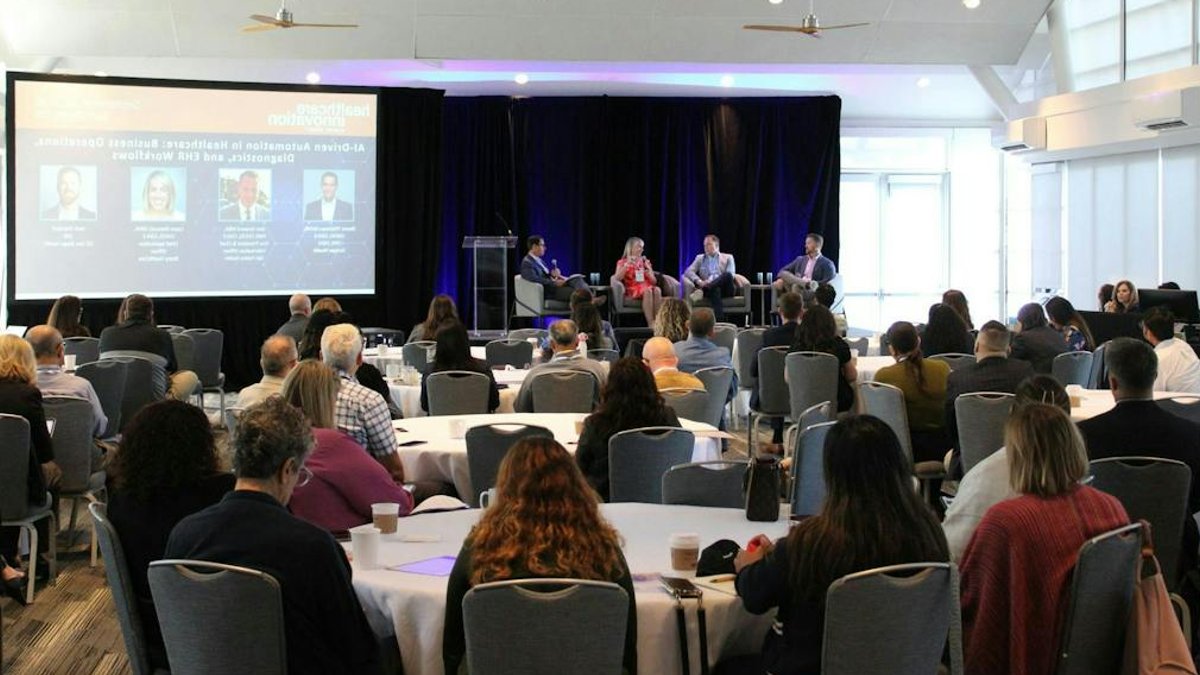
A year after artificial intelligence entered widespread discussion, healthcare executives in San Diego have moved past debating whether the technology should exist in medical settings. At the Healthcare Innovation San Diego Summit in September, participants focused squarely on execution—how to implement AI systems without introducing more complications than solutions.
The summit’s opening address, delivered by Shane Thielman, Scripps Health’s chief information and digital officer, established the event’s direction. While AI applications, ranging from generative models to real-time clinical assistants, are expanding rapidly, health systems face difficulties distinguishing genuine innovation from empty promises. The debate has shifted from whether AI will transform healthcare to how it can be adopted effectively without straining already overloaded operations.
Scripps Health has adopted a disciplined approach, assessing new technologies based on three core criteria: whether they improve clinician experience, enhance patient outcomes, and boost operational efficiency. The organization’s governance model demands rigorous scrutiny: Does the tool deliver measurable benefits, or does it simply add unnecessary layers? Can it be sustained without consuming excessive resources? Most importantly, does it address a problem that existing solutions have failed to resolve?
These questions moved beyond theory during a session on operating room automation. Jeff Reeves, UC San Diego Health’s perioperative informatics leader, demonstrated how sensors and machine vision could optimize documentation and equipment tracking. However, the conversation quickly turned to workflow integration. Introducing another system into an operating room, already a high-stress environment, risks increasing friction rather than productivity. Reeves and his team stressed that before deploying AI, health systems must determine whether the technology fixes an existing flaw or merely adds new demands to an already complex process.
Ambient AI moves from labs to hospitals
One practical development discussed was the growing adoption of ambient AI, which transcribes and analyzes clinician-patient interactions in real time. While this technology has progressed from experimental trials to active use, evaluating its effectiveness presents challenges.
Mario Bialostozky, Rady Children’s Hospital San Diego’s chief medical information officer, framed the issue directly: Healthcare organizations are moving from experimentation to practical AI implementation, focusing on measurable outcomes and value creation. Effective governance and clear success metrics are essential to evaluate AI technologies and avoid unnecessary complexity or investment in ineffective tools.
The transition from testing to real-world deployment has forced healthcare leaders to acknowledge difficult realities. Stephen Gutierrez, CIO of Northeast Valley Health Center, acknowledged that his organization is delaying AI adoption until critical concerns about data protection and clinician acceptance are addressed. Rady Children’s Hospital took an even more cautious approach, comparing two ambient AI vendors directly before selecting one. This method provided clearer insights into which solutions delivered results and which fell short.
Cybersecurity risks demand careful AI integration
Cybersecurity concerns also dominated discussions, highlighting that AI’s risks extend beyond clinical operations. Representatives from Kaiser Permanente and Keck Medicine of USC explained how AI strengthens defenses through improved threat detection while also creating new vulnerabilities, such as weaknesses in software updates or overdependence on unproven tools. The consistent message was clear: AI adoption must proceed deliberately, not impulsively.
By the summit’s conclusion, a central theme emerged: The future of AI in healthcare will not be determined by technology providers or academic researchers, but by the frontline staff who interact with these systems daily. Building trust, ensuring transparency, and achieving concrete results are not optional; they are essential conditions for success. The focus has shifted from whether AI will reshape medicine to how leaders can make these technologies function effectively in practice.





Leave a Reply